Halloween Pranks in the Early 1900s

The origins of Halloween go back over 2,000 years to medieval Europe, where children knocked on doors and begged for food and money. By the 19th century, youngsters in the United States celebrated October 31 by going door-to-door, singing songs, telling jokes and staging performances. Then in the 20th century, Halloween night became plagued with pranks and mischief. Most were harmless enough, but they weren’t always fun for the recipients. It is believed modern day trick-or-treating emerged as a way to bring order to the growing problems associated with the celebration, and to make Halloween safe for everyone.

One Halloween night, a group of Kaw City boys sneaked into W.T. Conklin’s barn located behind his house on the edge of town and kidnapped Conklin’s milk cow for the prank of all pranks. 

First, the boys had to halter the cow and connect the lead without anyone hearing them. Next, they had to steer the cow to the schoolhouse without anyone seeing them. But the biggest challenge facing them was coaxing the cow up the wide cement steps leading to the school’s broad double-door entry—the locked double-door entry.

One of the nameless boys was able to pick the lock and in they went…cow and all! That in itself, was quite a feat, but the boys weren’t finished yet. They had only made it to the grade school level. This cow was destined for high school on the second floor.

The stairs were steeper, divided by a landing and a turn, and to this day no one knows how they managed to get that cow to the second floor without a major disaster.

The next morning Glen and Hugo Conklin went to their barn to walk the milk cow out to the pasture and discovered she was missing. About the same time, school officials found the cow and the mess she had made and notified the Conklins to retrieve their cow.

Another Halloween antic which has never been forgotten involved a different group of boys and Mr. Boon’s outhouse. This event happened before indoor plumbing was available in most houses. The outhouse—a primitive  toilet facility—was a little wooden building located in the back of people’s homes. Most “outdoor johns” just had one hole, but some had two holes to accommodate larger families.

The plan was to turn Mr. Boon’s outhouse over on its side. They worked quietly to loosen it from the ground but when it fell over, it landed with a loud crash, awakening Mr. Boon. Minutes later, Boon threw open his back door and saw what they boys had done. He was angry, but didn’t want to hurt them so he only fired his rifle in the air to “scare them to death”. They ran like their life depended on it, but never received just punishment for leaving the Boons without their necessary facility until another outhouse could be built.

The actual Santa Fe outhouse from Old Kaw City was the caboose in the city’s “Last Official Day Parade”. It now sits on permanent display outside the Kaw City Museum. Locked doors prevent anyone from using the vintage outhouse for its original purpose.     

Kaw City Pictorial History Book Released at 2019 Reunion

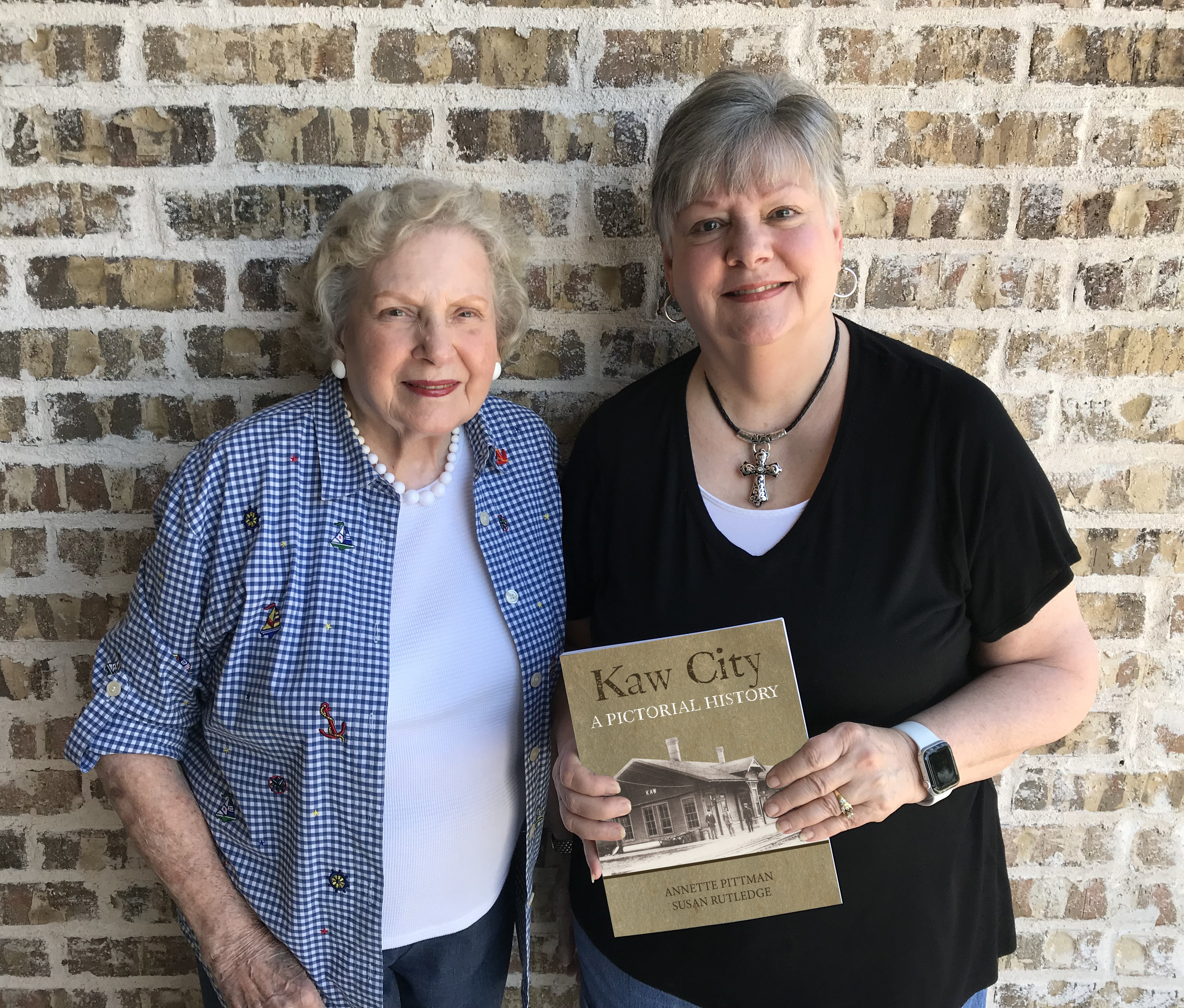
Former Kaw City resident Annette Conklin Cline Pittman and her daughter, Susan Rutledge timed the release of their new book, Kaw City – A Pictorial History, to coincide with Kaw City Museum’s 2019 Annual Reunion. Annette and her late husband Bob Cline, both born and raised in the Kaw City that is now covered by the waters of Kaw Lake, spent years collecting and copying vintage photographs loaned or donated to them by long-time Kaw City residents. Their goal was to preserve the history of the little town they grew up in. Great-grandchildren recently joined the project, spending countless hours digitizing the images, while the mother-daughter team organized them and documented known details such as dates, names and locations. The result is a book filled with copies of 200 photographs, most complete with historical details dating as far  back as the 1800s.

The book can be purchased at the Kaw City Museum for a donation of $20, with the entire donation going to the museum. For out-of-towners unable to visit the museum, email Carolyn Godberson csgodberson@gmail.com to make arrangements for shipping.

The Last Train (Almost)

Everybody in Kaw City knew when to expect the Santa Fe train to roll through the city. On slow, summer evenings, it wasn’t unusual for a crowd to gather on the north end of town by the grain elevator to watch it go by. But the town was being forced to move and soon the train tracks would be covered with deep waters from a new lake. December 10, 1971 marked a historic, if not sad occasion for the people of Kaw City. It was the final day the train would ever be scheduled to come through their town. People missed work and children were released from school so they could be there to witness the train chugging away from the depot one last time.

One man in particular must have been filled with nostalgia as he climbed onto the engine of the train that day. John Brown was once a water boy for the railroad, carrying tumblers and a kettle of water back and forth to passengers. He rode the first train that came into Kaw City, and he was there to ride the last train out.

John Brown (left) and Mayor Fred Munson (right) waiting to ride the last train out of Kaw City

Ironically, the train would make one more trip through Kaw City. Following heavy rains in Oklahoma, the only way for the train to get past flooded tracks was to be re-routed through the town. Unexpectedly, people were awakened in the middle of the night to hear that old familiar sound of their train rumbling by.

Kaw City Newspaper

The Kaw City Newspaper appeared shortly after the small Oklahoma town was established. News didn’t travel as fast in those days. Every letter of every word had to be set in place by hand. Typesetters labored for hours getting each page ready for print. They had to figure out where the “copy” would go and what size font they needed to use. Once the stories and designs were complete, they were locked into the bed of the press which was then inked. Paper was pressed against the inked type to make the impression which became the newspaper. This photo from circa 1902 shows the typesetters and printers at work.

The Kaw City Museum has some of the city’s old newspapers on display in the Brill building. The style of news writing was quite different in the early 1900’s and it’s fun to read some of the stories. You get a genuine peek into the past, reading about the Kaw City people and all the activities they were involved in.


Kaw City…In the Beginning

Located in Kay County, Kaw City is situated in the Ox Bow Bend of the Arkansas River twelve miles east of U.S. Highway 77 on State Highway 11. The town was established by the Kaw City Townsite Company, which included William M. Jenkins (fifth governor of Oklahoma Territory), N. F. Frazier, C. W. Carey, and W. E. Brown. The sale of town lots began on July 4, 1902. Advertised as “the finest Townsite in Oklahoma, having as a place for business land as level as a floor with gently sloping upland for residences,” it was bordered on the north by the Kaw (Kansa) Reservation and on the east by the Osage Reservation. Situated in a fertile and productive farming and cattle region, Kaw City was connected with outside markets when the Atchison, Topeka and Santa Fe Railway built their line through the town. Completed in 1903, the train depot served as a shipping point for thousands of bushels of corn and other farm produce. Hundreds of carloads of Texas cattle moved through Kaw City into the grazing lands of the Osage Reservation for fattening prior to being transported to market.

From the town’s inception, building progressed rapidly. Kaw City soon had a bank, a newspaper, two lumberyards, and a mill. A wagon bridge built across the Arkansas River to the north increased trade from the area known as Kaw Country. A post office was established on September 12, 1902, and a one-room school opened with fifty-six children in November 1902. At 1907 statehood, population stood at 486.

by Annette Pittman